4-element loop-fed Yagi, ROBUST — tapered FAT elements, flat over the whole FR4 εr bin
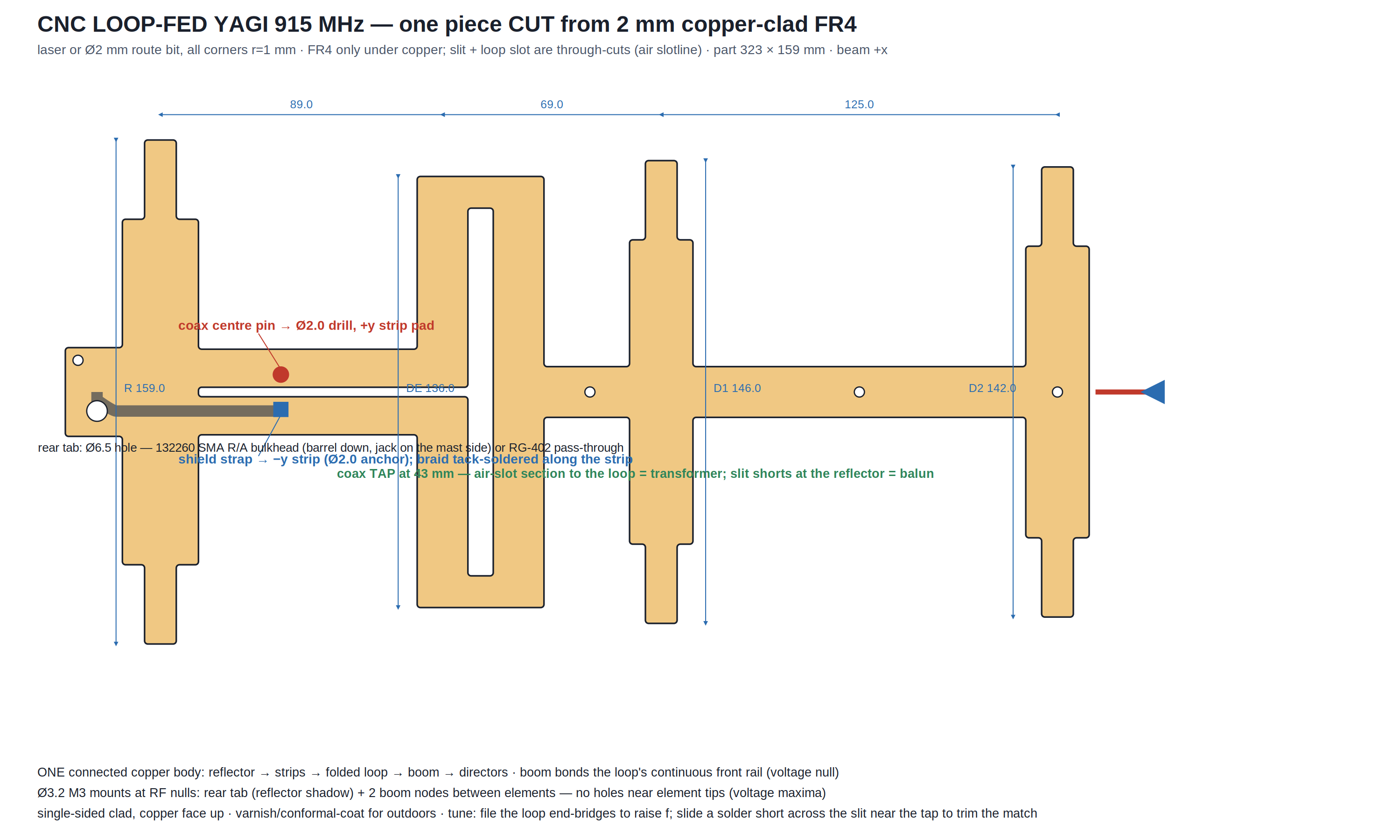
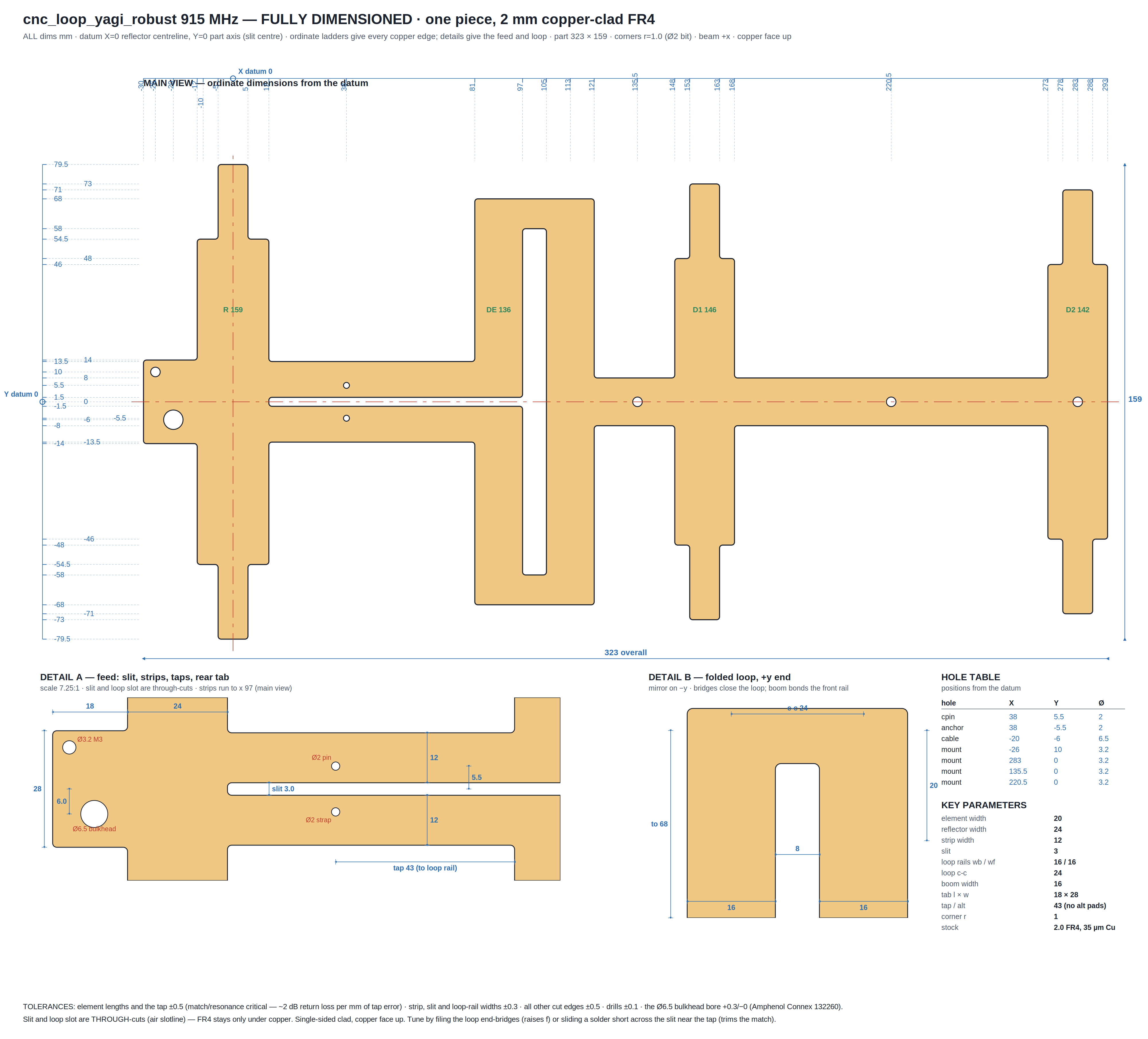
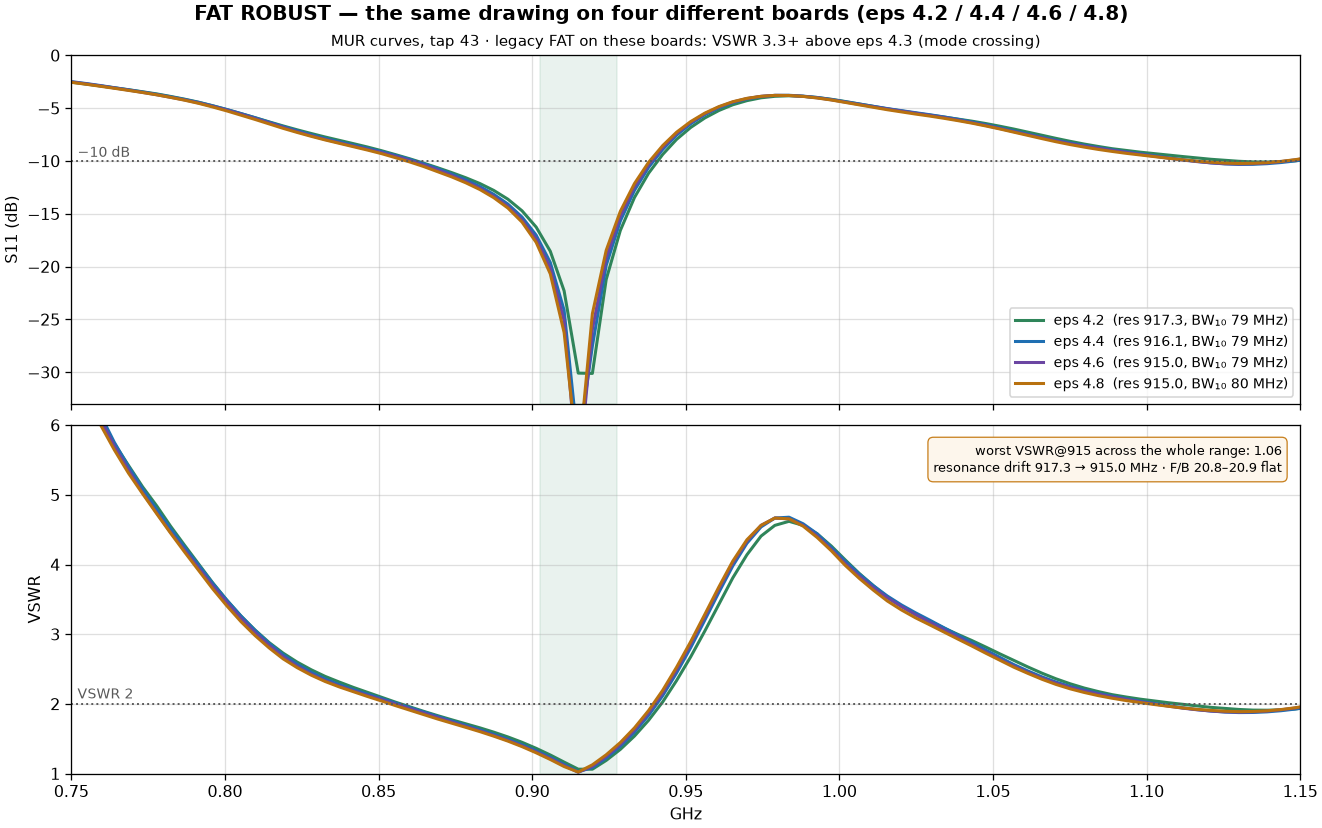
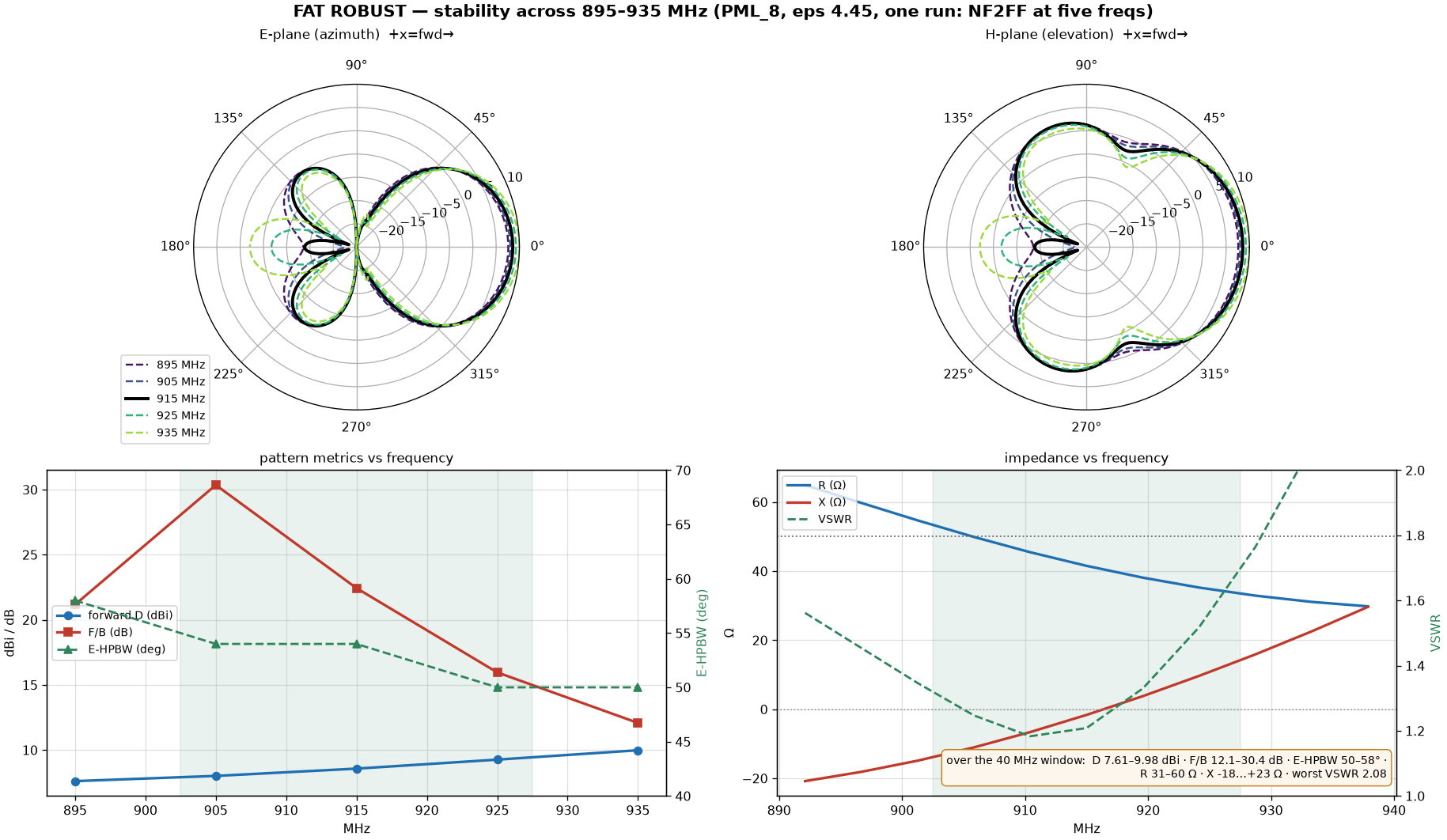
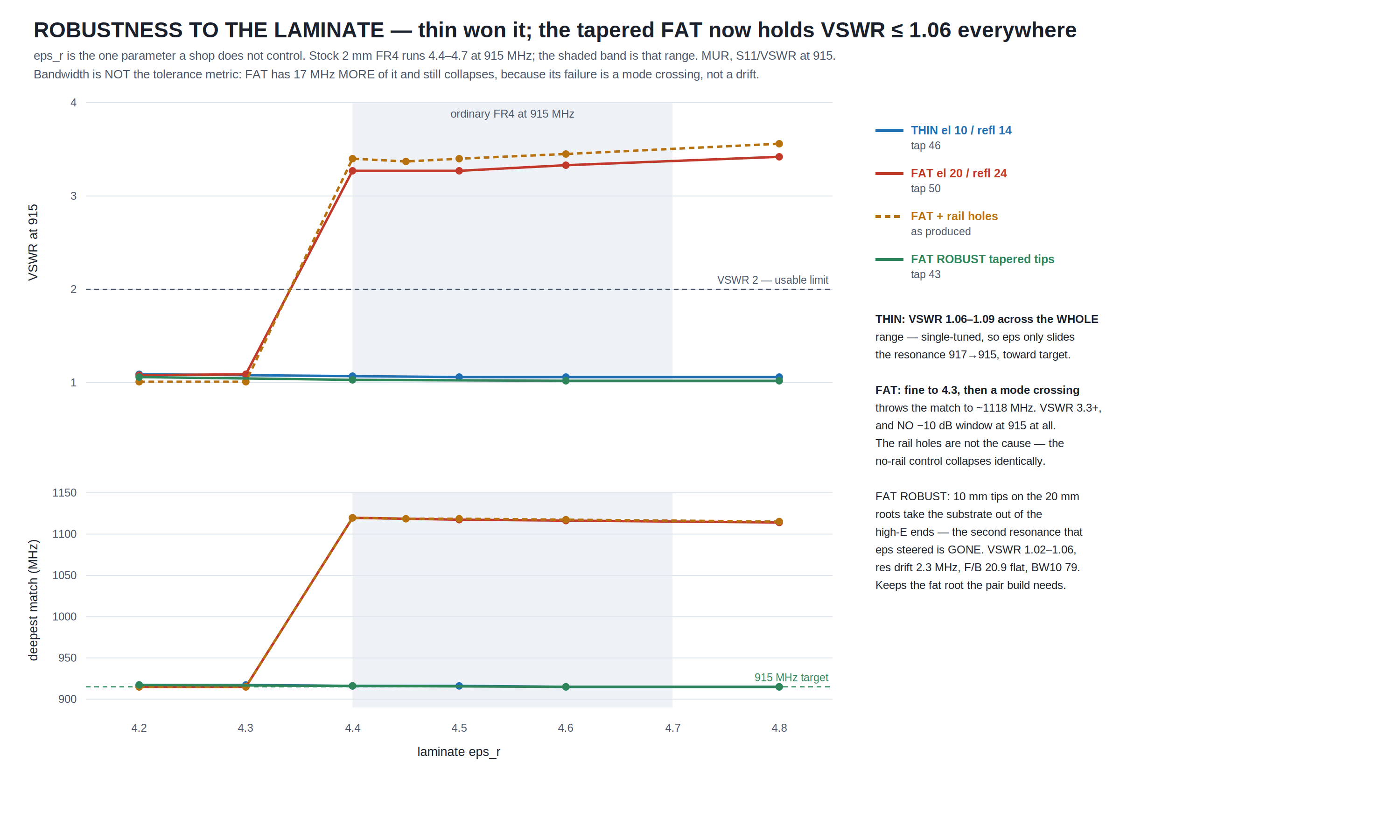
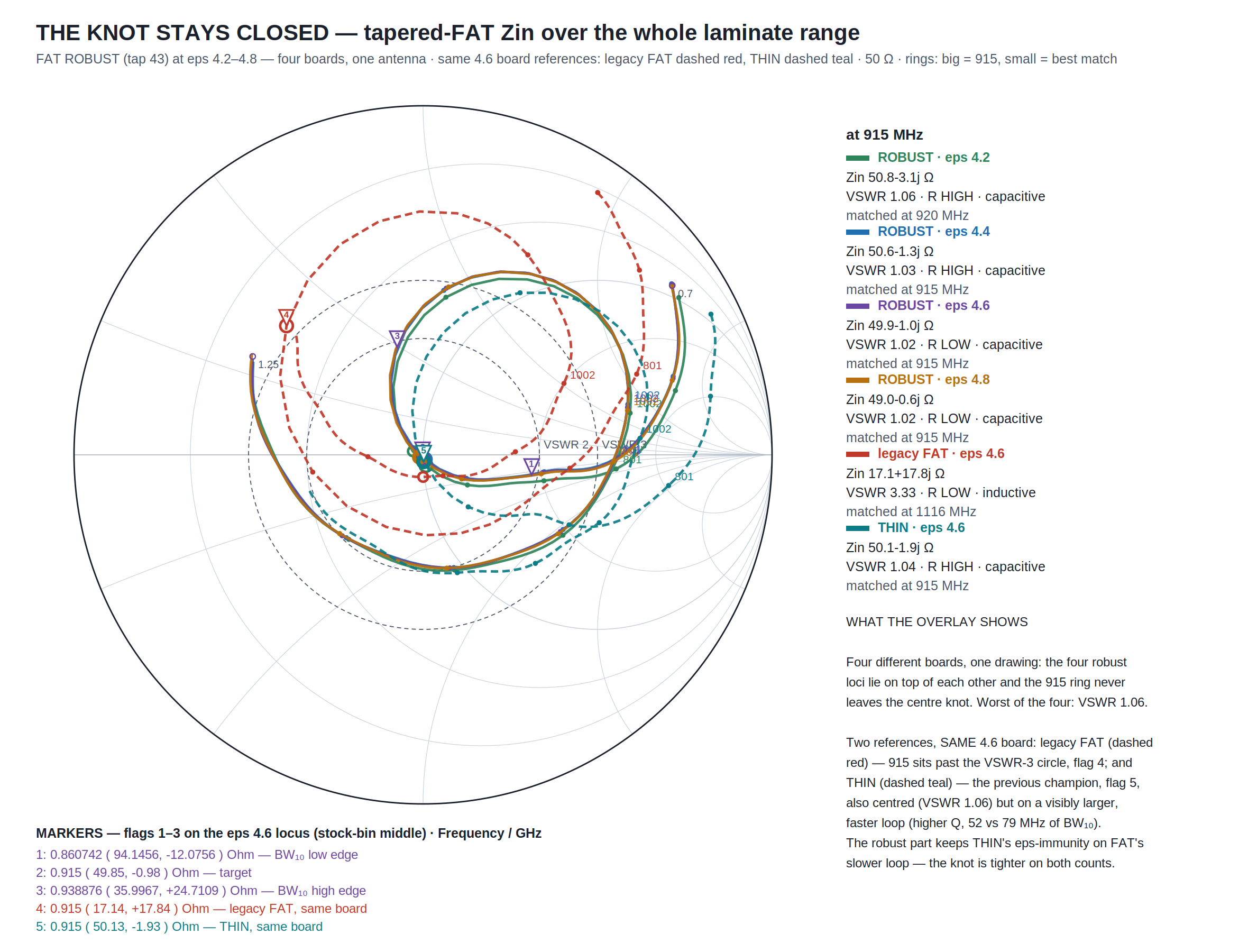
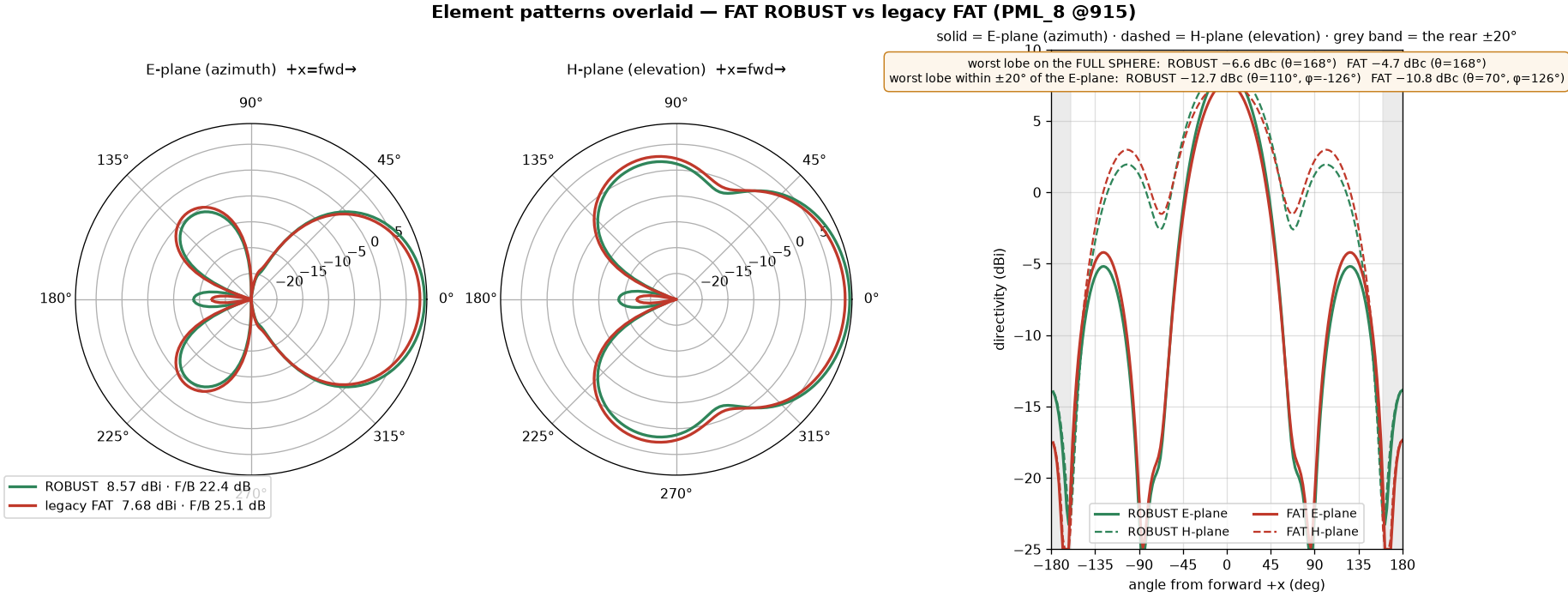
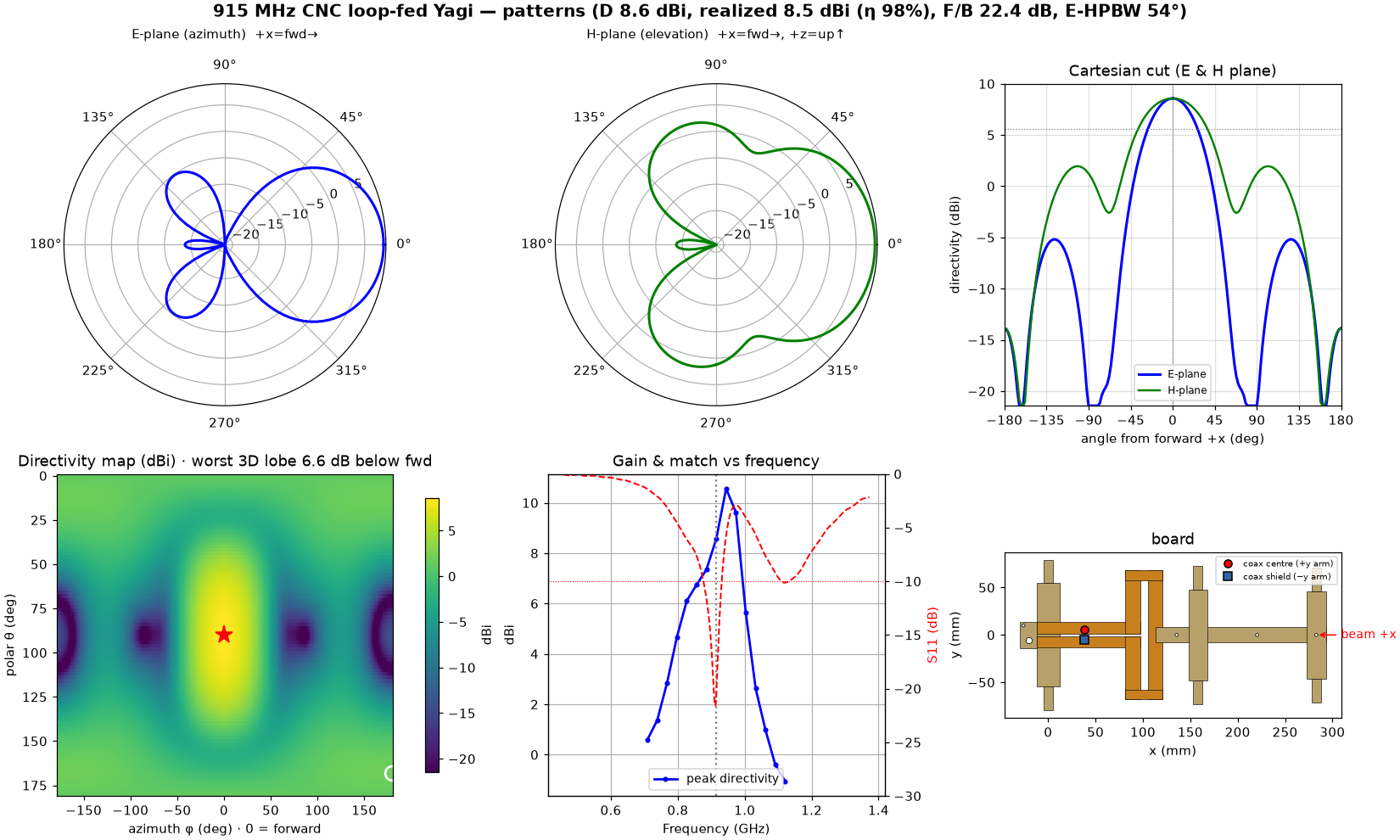
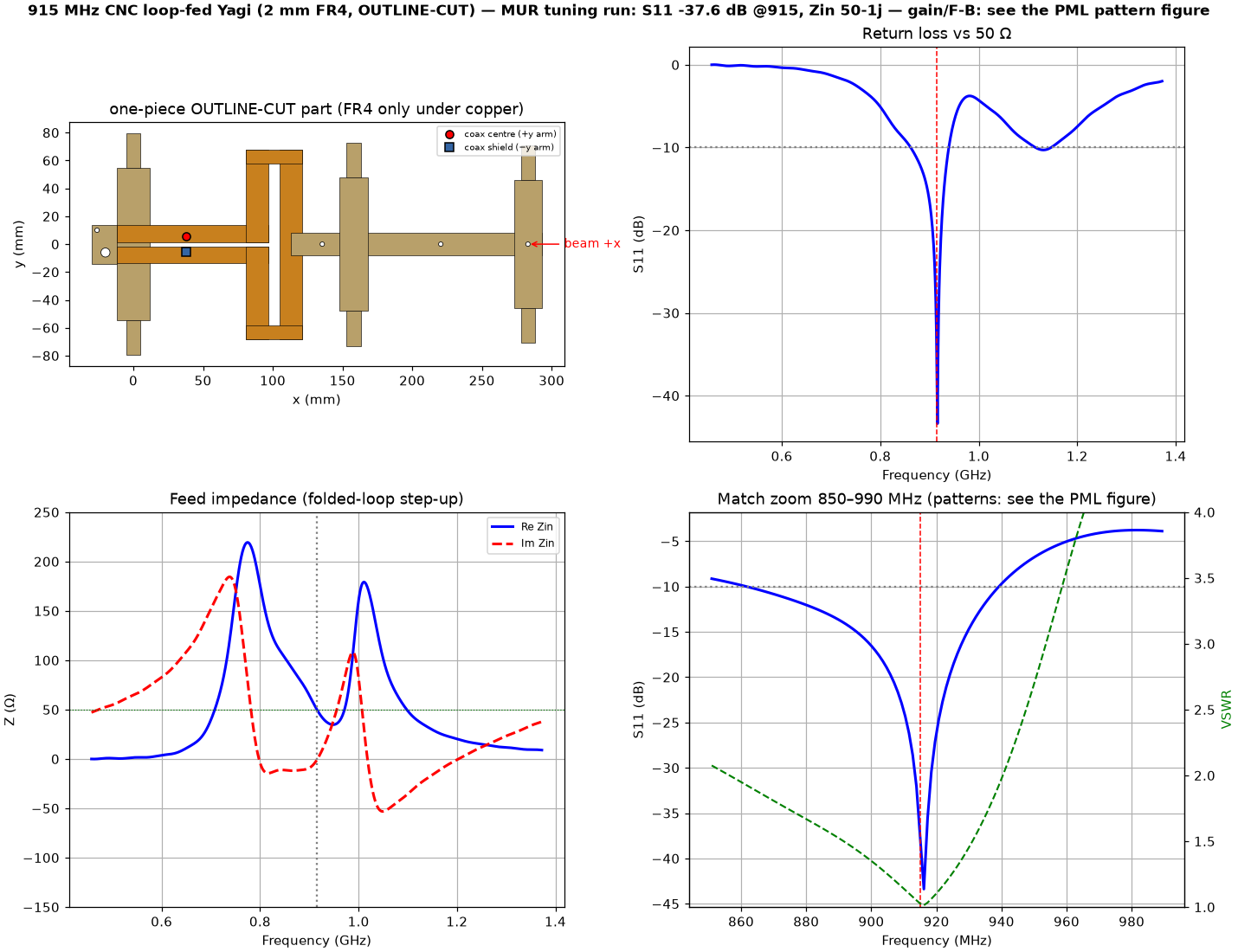
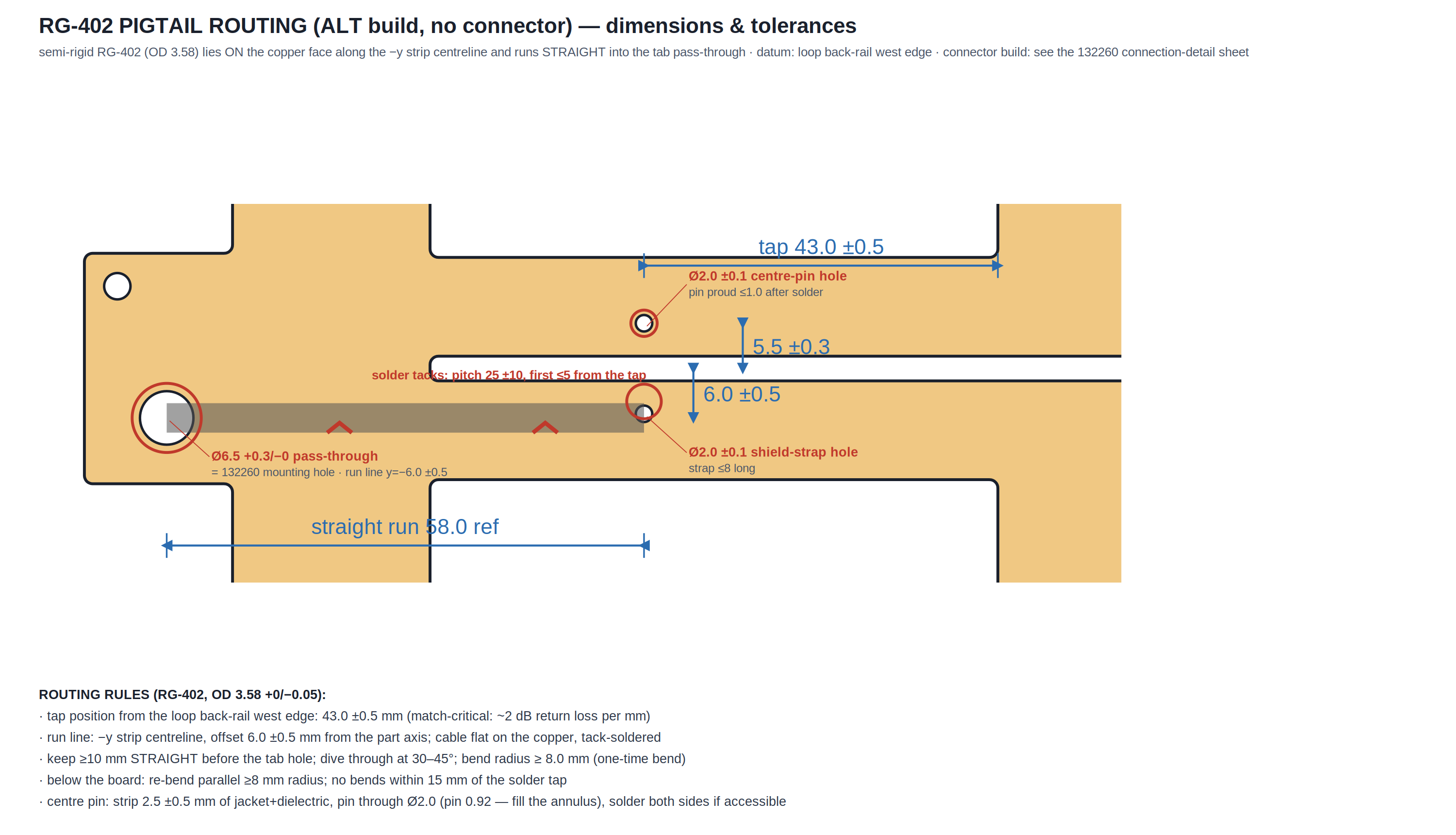
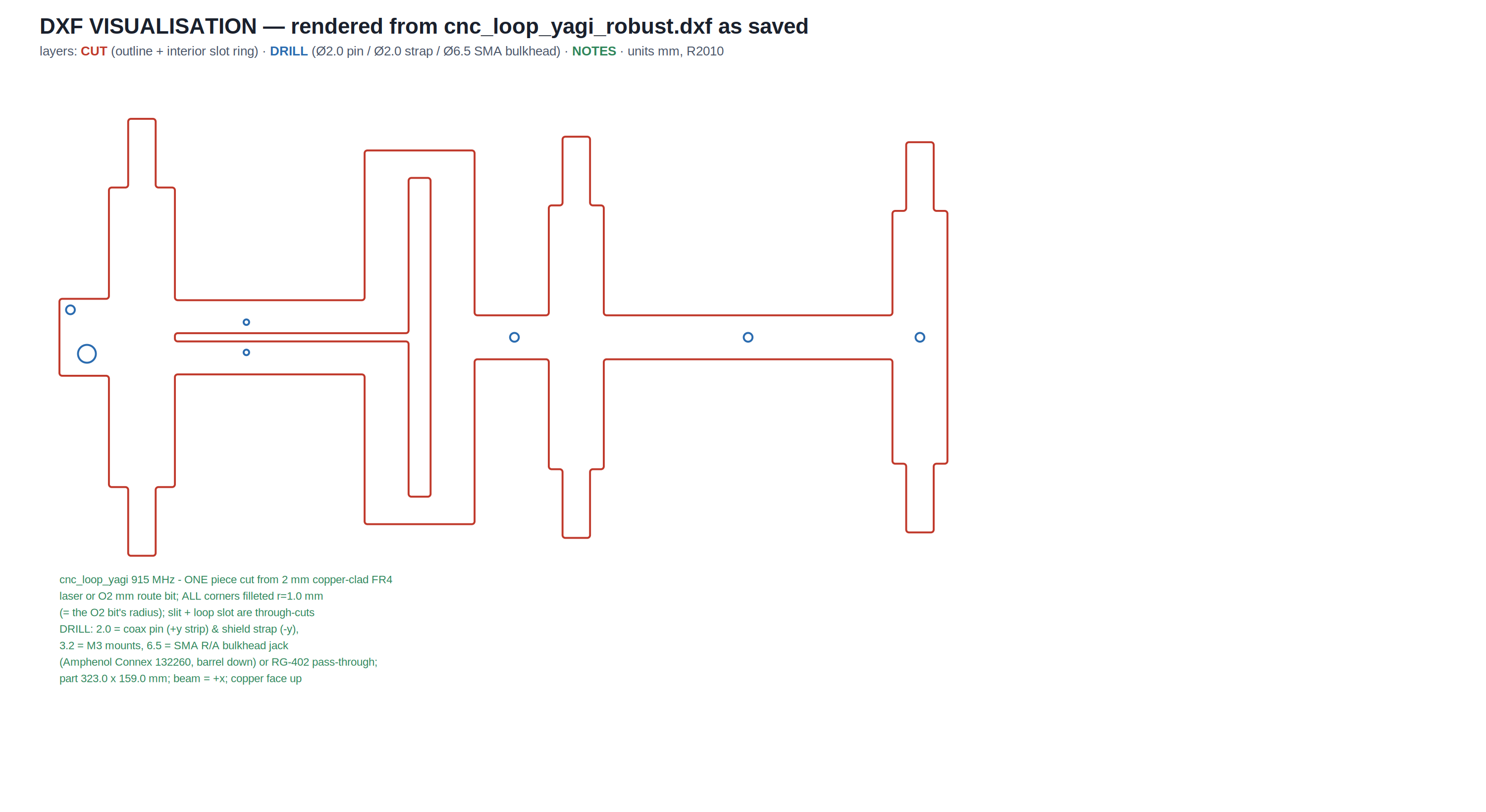
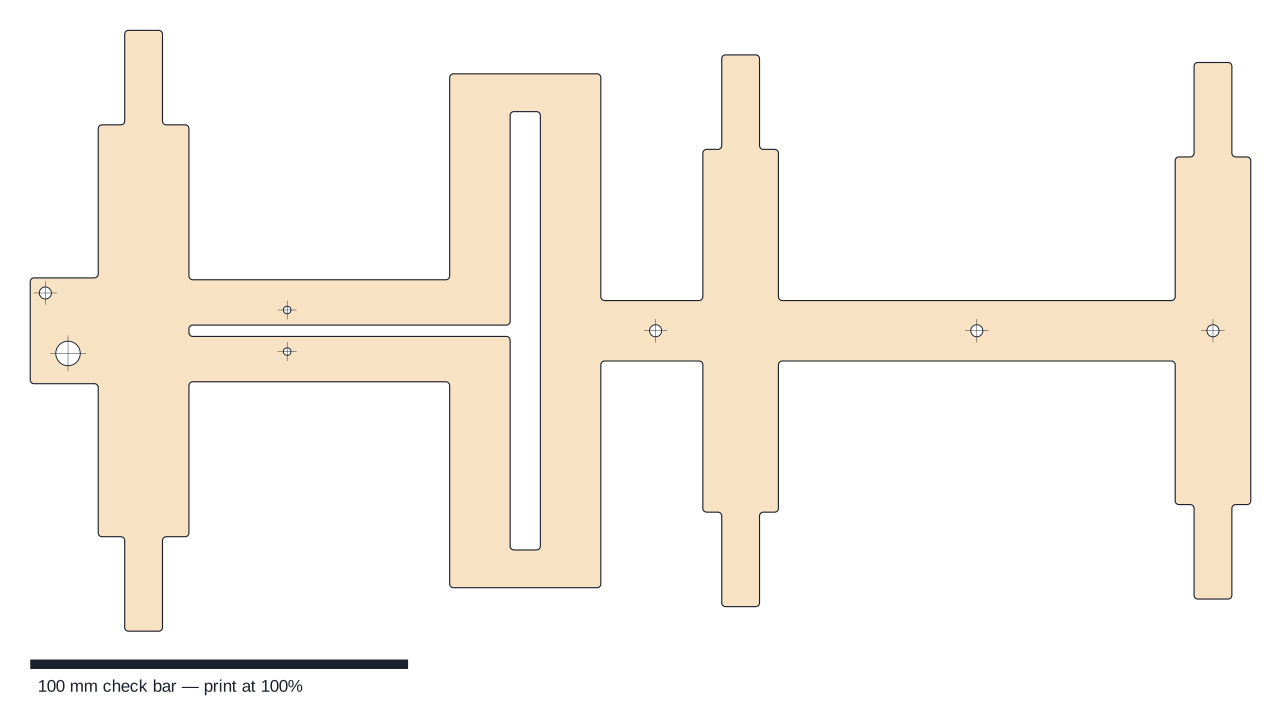
The tolerance lesson from the produced board, built into copper: robustness = worst-case over what the shop cannot control — the laminate εr (stock 2 mm FR4 runs 4.4–4.7 at 915), NOT bandwidth. Envelope verdict (::envelope, MUR, εr 4.2 / 4.4 / 4.6 / 4.8): worst VSWR@915 ≤ 1.06 ACROSS THE WHOLE RANGE (1.06 / 1.03 / 1.02 / 1.02) · resonance 917.3→915.0 (2.3 MHz total drift, toward target) · BW₁₀ 79–80 MHz · D 8.85→8.92 · F/B 20.8–20.9 — every figure flat. Same boards, legacy FAT: VSWR 3.3+ at εr ≥ 4.4 (the mode crossing that killed the produced part); THIN: 1.06–1.09 (flat but flexible). MECHANISM — tip taper: 10 mm-wide tips on the outer 25 mm of every parasitic; the 20/24 mm root stays where the bending moment lives, the tips go thin where the E-field (hence the dielectric pull) lives. εr pull drops 27 → ~5 MHz per 0.3 εr and the SECOND resonance whose relative position εr steered is gone — single-tuned like THIN, stiff like FAT. Loop end-bridges thinned to 10 mm to match. ARRAY RE-TUNE — a tapered strip is a stepped-impedance resonator sitting high, and a global dim_scale cannot restore array tuning (F/B collapses to 2–3 dB, measured): each parasitic gets +15 mm additive stretch (R 159 / D1 146 / D2 142), the loop stays 136 untrimmed, tap moves 50 → 43 — ONE pad pair; the alt-pair insurance is what the taper itself now provides. Tune point (εr 4.45, MUR): res 916.1, S11 −37.7 @915, Zin 50.4−j1.3, VSWR 1.03. PML_8 @915 (εr 4.45): 8.57 dBi D · 8.47 realized (η 97.6%) · F/B 22.4 dB · E-HPBW 54° · S11 −20.5, Zin 41.5−j1.6 · worst 3D lobe −6.6 dBc (θ=168° down-back class) · worst lobe within ±20° of the E-plane −12.7 dBc — vs legacy FAT: +0.9 dB forward, lobes ~2 dB quieter, F/B −2.7 (22.4 vs 25.1). Part 323×159 mm, same one-piece rules: outline cut, Ø2 bit, corners r=1, drills Ø≥2; Ø6.5 rear-tab hole (132260 SMA R/A bulkhead or RG-402 pass-through), Ø2 centre-pin + shield-strap pads, Ø3.2 M3 mounts at the RF nulls. No rail composition yet — the hole package is unverified on tapered elements. Downloads: DXF (CUT/DRILL) + STEP (FR4+copper solids) + 1:1 template + MUR & PML result JSONs. · 40 MHz-window stability (PML_8, one run, NF2FF at 895/905/915/925/935): main lobe steady — E-HPBW 58/54/54/50/50°, forward D 7.61/8.01/8.57/9.26/9.98 dBi (the gain dome sits slightly high: director resonance above band, standard 4-el dispersion) · F/B 21.2/30.4/22.4/16.0/12.1 dB — the in-window WORST (12.1, at 935) still beats the gerber quasi-Yagi card's 915 headline (9.1) · impedance at the PML plane: R 60→31 Ω, X −18…+23 Ω across the window, VSWR ≤ ~1.55 inside the ISM band and 2.08 only at the 935 extreme (MUR tap-plane curves: ≤ 1.1 across the whole window at every eps — the MUR→PML S11 shift is the same class seen on the legacy FAT/THIN finals) · STABLE sibling (own card): + one OWA matching director → F/B spread 3.3 dB and VSWR ≤ 1.45 across the ISM band with the eps-immunity kept — pick it for frequency-hopping DF; this card stays the max-F/B corner
⬗ stack-up: copper-clad FR4 2.0 mm · FAT roots (el 20 / refl 24) tapered to 10 mm tips over the outer 25 mm · +15 mm parasitic stretch, tap 43 single pair · part CUT to the copper outline (laser or Ø2 mm route bit, corners r=1) · FR4 only under copper · feed: Amphenol Connex 132260 SMA R/A bulkhead + RG-400 jumper (or bare RG-402 pigtail)
Why this variant exists — the εr post-mortem, condensed
A produced cnc_loop_yagi_rail board measured VSWR 3 on the bench while its model simulated −44 dB. Root cause (reproduced exactly in FDTD): the laminate's εr ≥ 4.4 — legacy FAT's match is double-tuned, the two resonances' relative position is εr-controlled, and past 4.4 the system mode-crosses to ~1118 MHz. Wide bandwidth did not protect it: BW is not tolerance when the failure is a mode crossing, not a drift. The THIN element demonstrated the fix criterion (single-tuned = εr-flat) but gives up the fat root's stiffness. This variant ends the trade: fat where the part bends, thin where the field lives. Four boards — εr 4.2 / 4.4 / 4.6 / 4.8 — one drawing: the Smith loci overlay within a line width, the 915 ring never leaves the centre knot (worst VSWR 1.06), and the S11 curves are indistinguishable. The legacy-FAT locus on the same 4.6 board sits past the VSWR-3 circle. Bench implication: no εr coupon, no alt-pad resolder, no tip filing — cut it and mount it.