Statistical resolution limit (SRL) — closest two targets tellable apart vs SNR · hover a point (session 014z DF model)
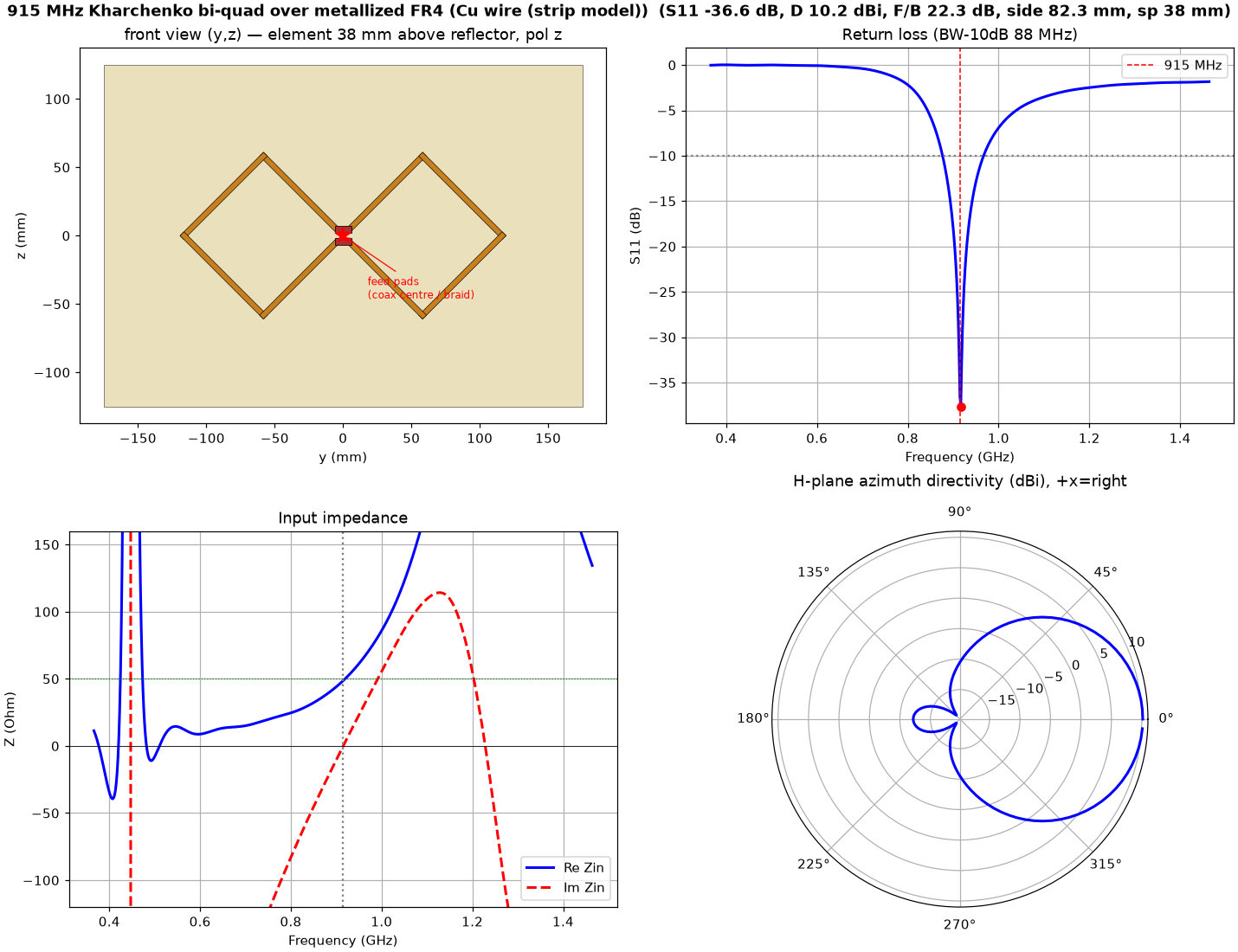
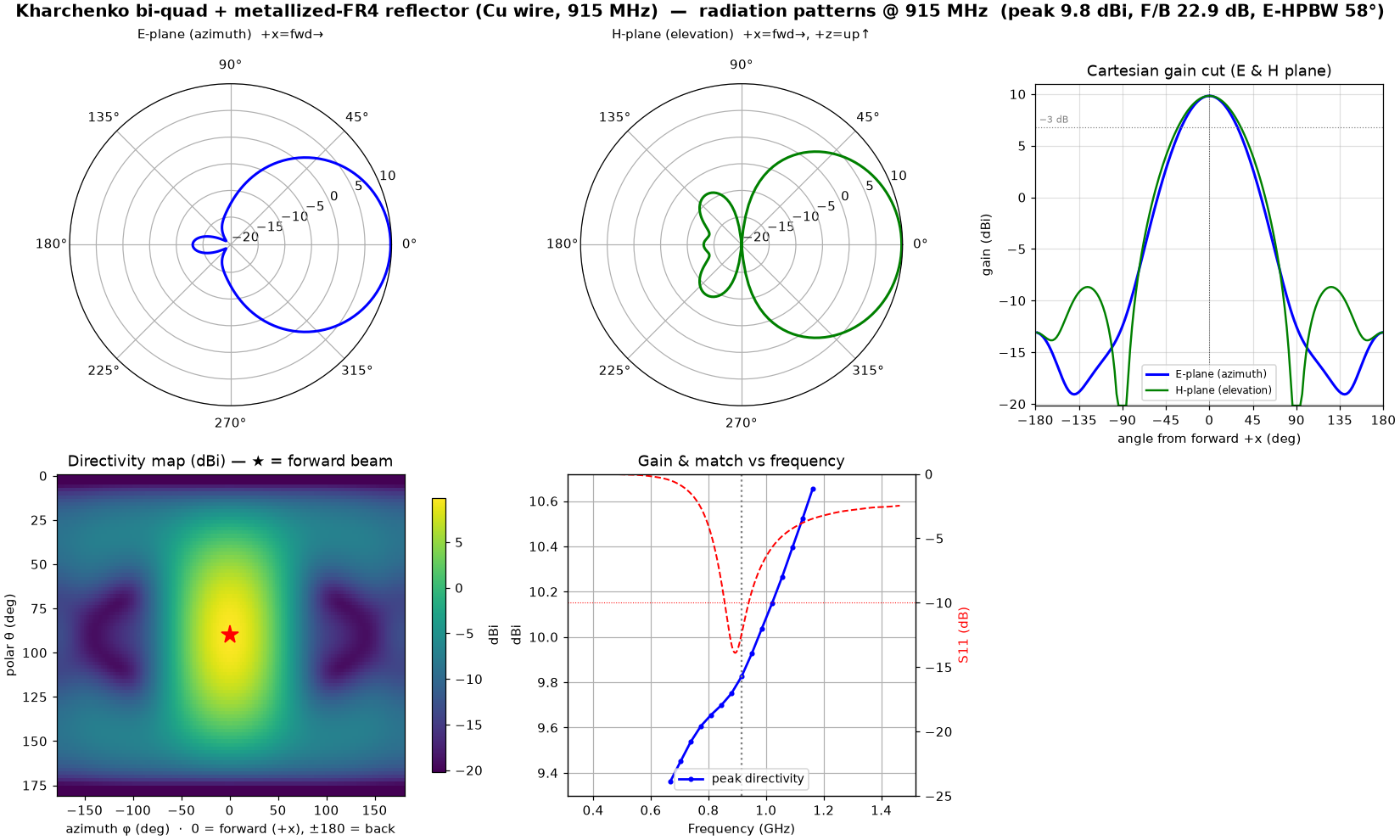
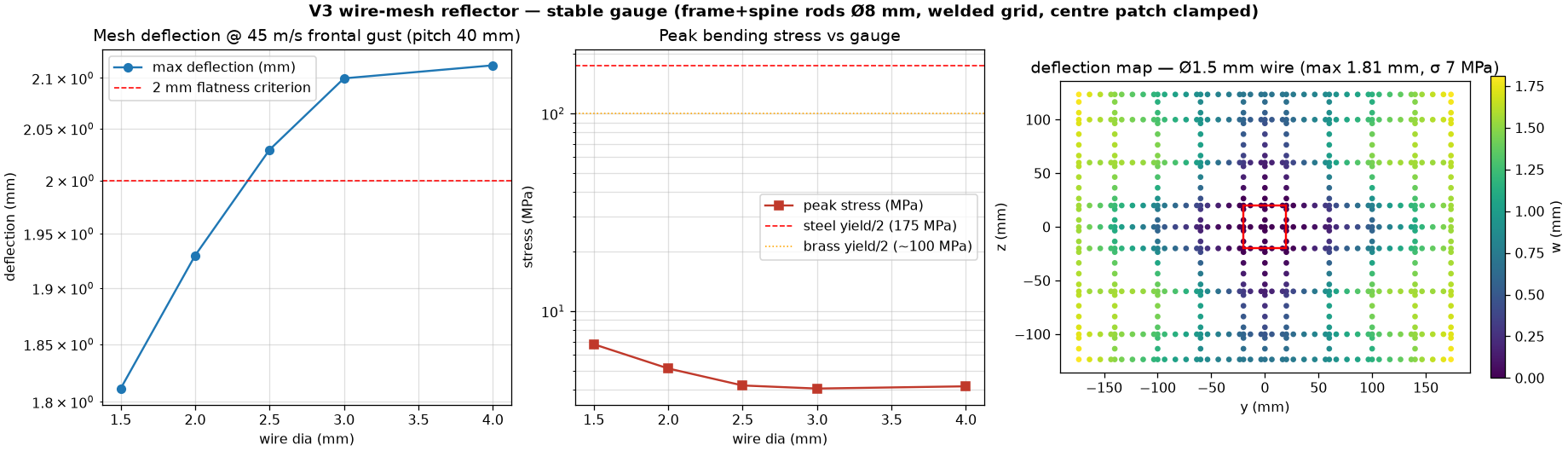
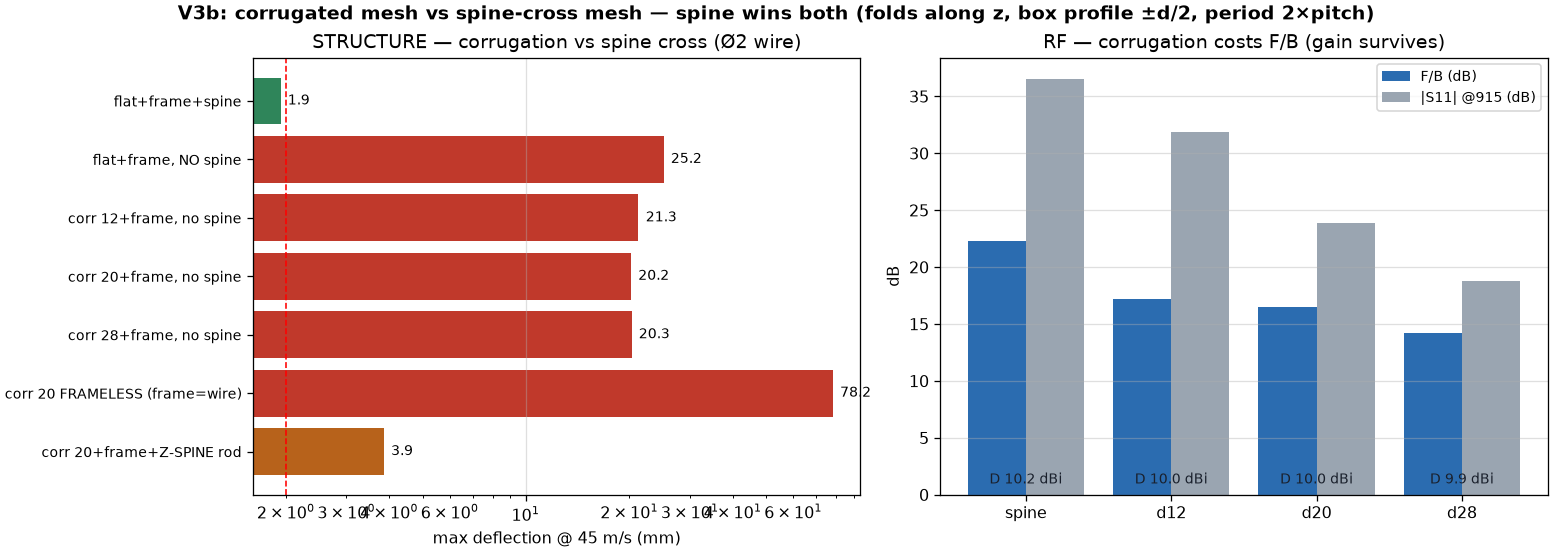
MESH PITCH 40 mm (0.12λ) is the largest within 1 dB of solid — PML: 9.85 dBi (−0.19 dB vs solid) · F/B 20.2 dB (+2.3 dB BETTER — pitch scan: p20 −0.10 dB, p30 −0.25, p40 −0.47 MUR, p60 −1.09 FAILS) · retuned: side 82.3, spacing 38 (mesh raises feed R; spacing pulls it back) → S11 −36.6 dB @915, Zin 48.6−j0.3, BW 88 MHz · element = same 2 mm Cu wire bi-quad · STABLE GAUGE (CalculiX beam-grid FEM, welded joints): pure grid on a centre mast is FLOPPY (Ø4 wire → 8.8 mm @45 m/s); with Ø8 frame+spine-cross rods ALL gauges hold ~2 mm — pick Ø2 mm wire (1.9 mm defl, 5 MPa; thicker wire is WORSE: drag grows faster than stiffness helps) · the spine cross also helps RF (restores the centre image plane: Zin 55→49 Ω, F/B +2 dB) · DRAG (lattice member-sum, EN 1993-3-1 style; direct CFD under-resolves 3 mm wires): solidity 0.19 → frontal 10.8 N @30 m/s = 5.5× LESS than solid (59 N), 45° 6.4 N, edge-on 5.8 N (CORRECTED: every vertical member is a crossflow cylinder at any panel yaw — an early leading-rod-only figure of 1.3 N undercounted; note the SOLID plate is actually lower-drag edge-on, 0.6 N), survival 24 N @45 m/s · same coax feed: collar bond to the 40×40 centre patch + ferrite choke · CORRUGATION STUDY (asked: corrugate instead of spines — REJECTED, spine cross wins both ways): box folds along z, ±d/2, period 2×pitch · STRUCTURE: corrugation stiffens the panel FIELD but not the LOAD PATH to the point clamp — corr d20+frame alone 20.2 mm @45 m/s (vs 1.9 mm spine cross); best hybrid (corrugation replaces only the HORIZONTAL rod, vertical Z-rod kept) 3.9 mm — still 2× worse · RF: gain survives (−0.15 dB) but the periodic folds diffract backward: F/B 22.3→16.5 dB (−5.9) at d20, −8 dB at d28, plus Zin drift · also harder to fabricate than two straight welded rods · F/worst-3D-lobe 16.6 dB
⬗ stack-up: 2 mm Cu wire element · reflector: welded steel wire grid Ø2 @ 40 mm pitch, Ø8 frame + spine cross, 350×250 mm, 40×40 solid centre patch